
Sonic Branding's Digital Comeback: AI's Role in Audio Success
Unlock the power of sound in the digital age. Learn how AI and sonic branding are revolutionizing audio marketing and elevating digital advertising strategies for modern brands. Dive in now!
Introduction: The Resurgence of Sound in a Visual World
In today's visually saturated digital landscape, a powerful sensory element is making a resounding comeback: sound. Sonic Branding, defined as the strategic use of sound to create a distinct brand identity, is experiencing a renaissance. Once relegated to catchy commercial jingles, audio is now a sophisticated and integral part of holistic brand strategies.
The evolution from simple jingles to complex sonic identities reflects the changing media landscape. Where once a simple tune advertised a product on television, now meticulously crafted audio architectures span across platforms. This shift has been spurred by the fragmentation of media consumption and the rise of new audio-centric channels. Increased podcast listenership, the proliferation of smart speakers, and sophisticated in-car entertainment systems have made audio more accessible and engaging than ever before. This evolution demands a new approach to Digital Advertising.
Brands are increasingly recognizing the importance of audio in driving Audio Engagement and reinforcing brand messaging. This blog post will explore the modern tools and strategies redefining sonic branding, including the transformative potential of AI Audio Advertising, the authenticity of UGC Audio Ads and how Audio Personalization can dramatically improve campaign performance. We will also delve into the Future of Audio Marketing and discuss how brands can use sound to cut through the noise and create lasting impressions in the digital age. Understanding these facets is crucial for effective Authentic Marketing and leveraging User-Generated Content.

Sonic Branding: The Digital Renaissance
- •Sonic branding is back and booming!
- •Digital channels offer unprecedented reach.
The Power of Sonic Branding: Why Audio Matters in the Digital Age
In the relentless pursuit of digital dominance, brands are increasingly recognizing the latent power of sound. Sonic Branding, the strategic use of audio to create a distinct brand identity, is experiencing a renaissance. This resurgence stems from the profound psychological impact of sound. Audio cues directly influence our emotions and memory encoding. Research indicates that auditory stimuli can trigger more vivid and emotional memories compared to visual cues. This is because the auditory cortex has direct connections to the amygdala (emotional processing) and the hippocampus (memory formation).
Sonic branding capitalizes on these neurological pathways to enhance brand recognition, recall, and loyalty. A well-crafted sonic logo or audio signature becomes inextricably linked to a brand in the consumer's mind. Consider McDonald's 'I'm Lovin' It' jingle; instantly recognizable and universally associated with the brand. Similarly, Netflix's 'Ta-Dum' soundmark, a mere few seconds, has become synonymous with the streaming giant, signaling the start of an immersive entertainment experience. These examples showcase the enduring power of commercial jingles, now evolved into sophisticated sonic strategies.
Statistical evidence further bolsters the case for audio's effectiveness. Studies consistently demonstrate that audio advertising, when implemented strategically, rivals and sometimes surpasses the performance of traditional visual ads. Audio ads often exhibit higher completion rates and lower skip rates, especially within platforms like Spotify and podcasts. Furthermore, integrating sound into digital advertising campaigns can significantly boost brand recall, with some studies reporting increases of up to 24% compared to purely visual campaigns. This underscores the importance of sound in driving audio engagement and solidifying brand messaging. The shift towards Authentic Marketing with UGC Audio Ads and the personalization opportunities within Audio Personalization signify a broader recognition of audio's potential, influencing the Future of Audio Marketing, including AI Audio Advertising. In essence, sound provides a unique pathway to capture attention and forge lasting connections in an increasingly noisy digital landscape.
AI Audio Advertising: Revolutionizing Sonic Branding
AI Audio Advertising: Revolutionizing Sonic Branding
The landscape of sonic branding is undergoing a seismic shift, largely driven by the capabilities of Artificial Intelligence (AI). AI Audio Advertising is no longer a futuristic concept; it's a present-day reality reshaping how brands connect with audiences through sound. This section delves into how AI is revolutionizing audio advertising, from personalized experiences to the creation of unique sonic identities.
One of the most impactful applications of AI lies in audio personalization. AI algorithms analyze user data – listening habits, demographics, even contextual factors like weather or location – to deliver highly targeted audio ads. Imagine a user streaming a workout playlist receiving an ad for energy drinks, dynamically altered to match the music's tempo and genre. This level of granularity significantly boosts audio engagement compared to generic commercial jingles.
Furthermore, AI powers dynamic ad creation. Platforms like Jukebox, an AI model by OpenAI, can generate original music compositions based on textual descriptions. A brand could input "upbeat, positive music for a summer campaign," and the AI would produce several unique tracks. This eliminates the need for costly composers and licensing fees, while ensuring a distinctive sonic identity. This tech is important to the Future of Audio Marketing.
Beyond content creation, AI enhances ad targeting and optimization. AI-driven platforms analyze campaign performance data in real-time, identifying patterns and adjusting bidding strategies to maximize reach and conversion rates. For instance, an AI could determine that ads featuring a particular voice actor resonate better with a specific demographic and automatically prioritize those ads. The use of AI has changed Digital Advertising.
Several platforms are leading the charge in AI Audio Advertising. Veritone, for example, offers an AI-powered ad network that analyzes audio content to ensure ads are contextually relevant. Spotify's Ad Studio incorporates AI-driven targeting and optimization features. These technologies allow brands to move beyond basic demographic targeting and leverage granular insights to deliver highly effective audio campaigns.
The rise of UGC Audio Ads and Authentic Marketing also benefits from AI. While User-Generated Content provides a sense of authenticity, AI can be used to moderate and curate this content, ensuring brand safety and consistency. AI algorithms can analyze audio quality, identify potentially offensive language, and even assess the emotional tone of UGC audio submissions.
Key Takeaways
- AI enables hyper-personalization in audio advertising through data analysis and dynamic content adaptation.
- AI can generate original music and sonic identities for brands, reducing costs and ensuring uniqueness.
- AI-powered platforms optimize ad targeting and bidding strategies in real-time.
- AI aids in curating and moderating UGC audio content for brand safety and consistency.
The Rise of UGC Audio Ads: Authentic Marketing Through Sound
The proliferation of digital platforms has catalyzed a significant shift towards User-Generated Content (UGC), and this trend is now profoundly impacting the realm of audio. UGC Audio Ads represent a powerful frontier in modern Digital Advertising, offering brands an unparalleled opportunity for Authentic Marketing through the voices of their actual consumers. The benefits are multifaceted: first, authenticity is paramount. Unlike meticulously produced Commercial Jingles, UGC audio inherently carries a higher degree of credibility, as it originates from genuine user experiences. This authenticity fosters stronger emotional connections and boosts consumer trust. Second, they are remarkably cost-effective. By leveraging content created by users, brands can significantly reduce traditional production overheads associated with professional studio recordings and talent. Third, UGC campaigns inherently drive higher Audio Engagement because the content often resonates more deeply with target audiences who see themselves reflected in the messaging. Brands can encourage UGC audio through various strategic avenues, such as social media challenges on platforms like TikTok or Instagram, interactive contests requiring audio submissions, or even dedicated microsites for voice testimonials. Curating this content effectively is crucial; while platforms offer robust moderation tools, supplementing these with AI-driven content analysis, a concept closely related to the advancements in AI Audio Advertising, can help identify relevant and high-quality submissions efficiently. Ensuring brand safety and compliance is non-negotiable. This involves stringent content moderation processes, both automated and human, to filter out inappropriate or off-brand submissions. Crucially, brands must secure proper rights and consent from creators for the commercial use of their audio, clearly outlining usage terms and any potential compensation. Disclosure of sponsored content, if applicable, also maintains transparency. Successful examples span industries: a popular coffee brand might launch a campaign asking users to share their morning coffee rituals in short audio clips, creating a relatable and diverse sonic tapestry that enriches its Sonic Branding. Similarly, tech companies can utilize UGC audio for authentic product reviews or 'unboxing' soundscapes, proving more impactful than generic endorsements. As we look towards the Future of Audio Marketing, UGC audio ads, potentially enhanced by Audio Personalization techniques, will continue to play a pivotal role in amplifying brand messages in an increasingly noisy digital soundscape.
Key Takeaways
- UGC Audio Ads drive authentic marketing, fostering trust and emotional connection through genuine user voices.
- These ads are highly cost-effective, reducing production overheads compared to traditional commercial jingles.
- UGC audio campaigns significantly boost audio engagement due to their relatable and peer-driven nature.
- Brands can encourage UGC via social challenges, contests, and dedicated platforms, using AI-driven tools for efficient content curation.
- Ensuring brand safety, compliance, and securing creator rights are critical for successful and ethical UGC audio advertising campaigns.
Audio Personalization: Tailoring Sound to the Individual
Audio Personalization represents a critical frontier in modern Digital Advertising, moving beyond generic "Commercial Jingles" to craft bespoke auditory experiences that significantly enhance Audio Engagement. The goal is to make every interaction feel uniquely tailored, fostering a deeper connection between brand and consumer, ultimately strengthening Sonic Branding.Implementing effective Audio Personalization hinges on sophisticated data-driven strategies. Brands leverage granular user data – including demographics, browsing history, purchase behavior, listening habits, and real-time contextual information (e.g., location, time of day) – to dynamically adjust audio elements. This process often involves AI Audio Advertising platforms that can analyze vast datasets to predict user preferences and generate or select appropriate audio cues. For instance, a streaming service might dynamically insert an ad with a specific musical style if the user frequently listens to that genre, or a retail app could use a personalized voice prompt with relevant offers upon entering a store. In podcast advertising, AI can serve different narrative versions of a brand's message based on a listener's inferred interests, making each ad feel less intrusive and more relevant.Consider platforms where programmatic audio exchanges dynamically serve variations of a brand's audio message. A single brand might possess multiple versions of its audio logo or a short jingle, with AI determining which variant is most likely to resonate with an individual listener based on their profile. This extends beyond simple ad delivery; personalization also applies to interactive voice assistants where responses are tailored to user history, or within gaming environments where dynamic soundscapes adapt to player actions and preferences. This adaptive approach is foundational to the Future of Audio Marketing, pushing towards more responsive and individually relevant auditory environments.However, the power of Audio Personalization comes with significant ethical considerations and privacy concerns. The collection and utilization of personal data for such granular targeting raise critical questions about data security, transparency, and user consent. Brands must prioritize clear opt-in mechanisms, provide easily accessible privacy policies, and ensure data anonymization where possible. Over-personalization, or the perception of it, can also lead to a "creepy" factor, alienating users rather than engaging them. Striking the right balance between delivering relevant content and respecting user privacy is paramount for building trust and achieving effective Authentic Marketing. This also applies to the integration of UGC Audio Ads, where user-generated content could be personalized, necessitating robust consent frameworks for both creation and targeted distribution.
Key Takeaways
- Audio personalization enhances user engagement by tailoring auditory experiences to individual preferences.
- Data-driven strategies, often powered by AI, are crucial for dynamic audio adjustment based on granular user data and real-time context.
- Personalization extends beyond ads to interactive experiences like voice assistants and adaptive soundscapes, shaping the future of audio marketing.
- Significant ethical considerations and privacy concerns, including data security, transparency, and user consent, must be addressed in audio personalization.
- Balancing relevance with respecting user privacy is essential to avoid alienating users and to achieve authentic and trusted marketing.
Future Trends in Audio Marketing: Voice, Spatial Audio, and Beyond
The proliferation of voice assistants and smart speakers is rapidly reshaping the landscape of Digital Advertising. Voice-activated advertising, fueled by advancements in natural language processing and AI Audio Advertising, enables frictionless interactions where users can engage with brands simply by speaking. This shift necessitates a refined approach to Sonic Branding, moving beyond visual cues to ensure a distinct and recognizable audio identity in conversational interfaces. Brands must consider how their voice persona, prompts, and audio feedback contribute to an intuitive user experience.Beyond mere interaction, spatial audio is poised to revolutionize immersive brand experiences. By simulating sound from various directions, spatial audio creates a three-dimensional soundscape, vastly enhancing Audio Engagement and narrative depth. Imagine an e-commerce platform where product descriptions are delivered with spatialized audio, placing the listener 'within' the experience, or a virtual event where keynote speakers are heard from a specific virtual stage location. This technology becomes even more potent when integrated with augmented reality (AR) and virtual reality (VR) technologies. In AR/VR, audio, especially spatial audio, is critical for establishing presence and immersion, making virtual environments feel truly real. Brands can leverage this for interactive product demos, virtual showrooms, or gamified experiences where audio cues guide the user.The Future of Audio Marketing will see Sonic Branding evolve far beyond traditional Commercial Jingles. Advanced Audio Personalization, driven by user data and AI, will deliver highly tailored sonic experiences. We can anticipate an increased demand for Authentic Marketing through new forms of User-Generated Content (UGC Audio Ads) within these immersive soundscapes, where consumers contribute to a brand's evolving sonic identity. The synergy of voice, spatial audio, and mixed reality will create a new paradigm for brand interaction, making sound an even more powerful, indispensable element of the digital brand strategy.
Key Takeaways
- Voice-activated advertising, powered by AI, demands distinct sonic brand identities for frictionless conversational interactions.
- Spatial audio creates immersive, three-dimensional soundscapes, significantly enhancing user engagement in brand experiences.
- Integration with AR/VR technologies will make spatial audio crucial for establishing presence and immersion in virtual environments.
- The future of sonic branding will involve advanced audio personalization, evolving beyond traditional jingles into highly tailored, interactive sound strategies.
- Expect new forms of user-generated audio content to emerge within these immersive contexts, driving authentic marketing efforts.
Conclusion: Amplifying Your Brand's Voice in the Digital Realm
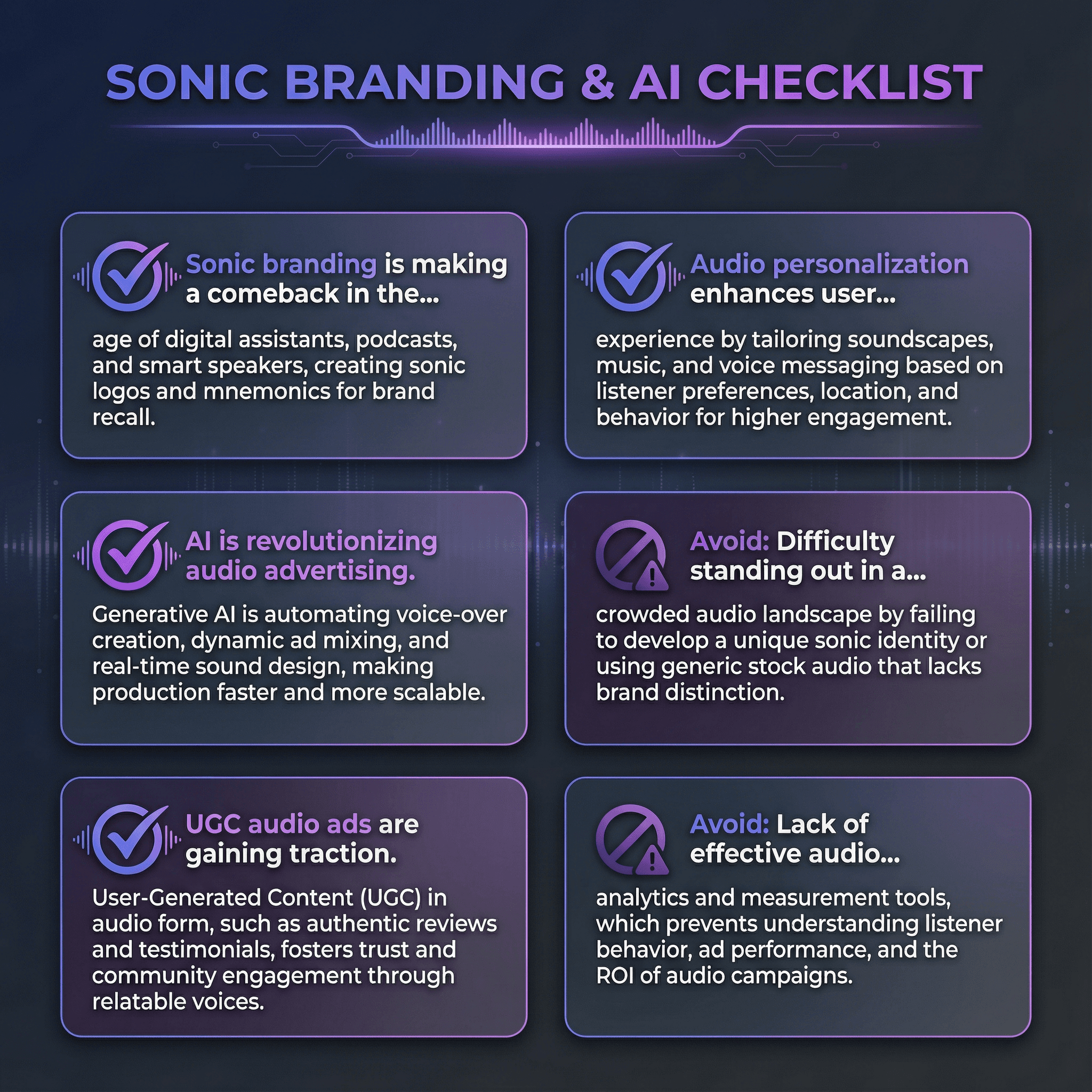
In a digital realm saturated with visual stimuli, the strategic deployment of "Sonic Branding" has emerged as a critical differentiator. We’ve explored how sound transcends mere background noise, fostering profound emotional connections and elevating brand recognition far beyond traditional "commercial jingles". From the precision of "AI Audio Advertising" personalizing experiences to the genuine resonance of "UGC Audio Ads" driving "Authentic Marketing" through "User-Generated Content", audio is no longer an afterthought but a cornerstone of effective "Digital Advertising". For brands seeking to amplify their voice, the path forward involves several key steps. First, establish a distinct sonic identity – a unique audio signature that embodies your brand's essence. Second, embrace the transformative power of technology, leveraging "AI Audio Advertising" for dynamic content generation and optimizing "Audio Personalization" to resonate with individual listeners. Third, cultivate "User-Generated Content" initiatives to foster organic "Audio Engagement" and authentic connection. Finally, look ahead to the "Future of Audio Marketing", preparing for advancements in spatial audio and voice-activated interfaces. The enduring power of sound to shape perception and forge indelible connections makes neglecting this channel a missed opportunity. Embrace sonic strategy not just as an option, but as an imperative for digital success.
Key Takeaways
- Sonic branding is essential for digital differentiation and fostering emotional connections beyond traditional jingles.
- AI Audio Advertising and UGC Audio Ads offer powerful tools for personalized, authentic digital marketing and enhanced audio engagement.
- Brands should define a distinct sonic identity, leverage AI for dynamic content and personalization, and cultivate user-generated audio.
- The future of audio marketing requires adapting to trends like spatial audio and voice interfaces.
- Strategic audio engagement is imperative for amplifying brand voice and achieving digital success.
Create Your Own Audio Ad
Turn this inspiration into reality. Generate a professional jingle or UGC ad in minutes.
Ready to Get Started?
Join thousands of businesses creating professional audio ads with AI.

Michael Shaw
Founder & CEO
Founder of SonicBrand AI, passionate about revolutionizing audio marketing through AI-powered solutions.
Ready to Create AI-Powered Audio Ads?
Generate professional jingles and audio UGC ads in minutes. No audio experience required.